
Geospatial Naming System — The Identity Layer the Internet Never Had
Patent Pending #63/948,788 · IETF Internet-Draft draft-ayerbe-trip-protocol-02 (co-authored with Usama Sardar, IETF RATS WG)
GNS is to identity what DNS is to domains — a naming resolution protocol.
GNS combines three protocol innovations:
@handle → public keydid:gns: methodVerify any GNS identity with a single HTTP request:
$ curl https://gns-browser-production.up.railway.app/v1/verify/@camiloayerbe

{
  "verified": true,
  "handle": "@camiloayerbe",
  "trust_score": 90.68,
  "breadcrumb_count": 933,
  "verification_level": "maximum",
  "chain_valid": true
}
933 breadcrumbs proving humanity through movement patterns. "maximum" verification level achieved.
Digital identity is fundamentally broken.
Authentication services like Auth0 and Okta can answer "is this the right user?" but they cannot answer the more fundamental question: "is this a real human?"
Prove you're human by how you move through the world.
Instead of scanning your eyeball, GNS builds trust through behavioral proof: your unique pattern of movement over time creates an unforgeable signature that only a real human being can produce.
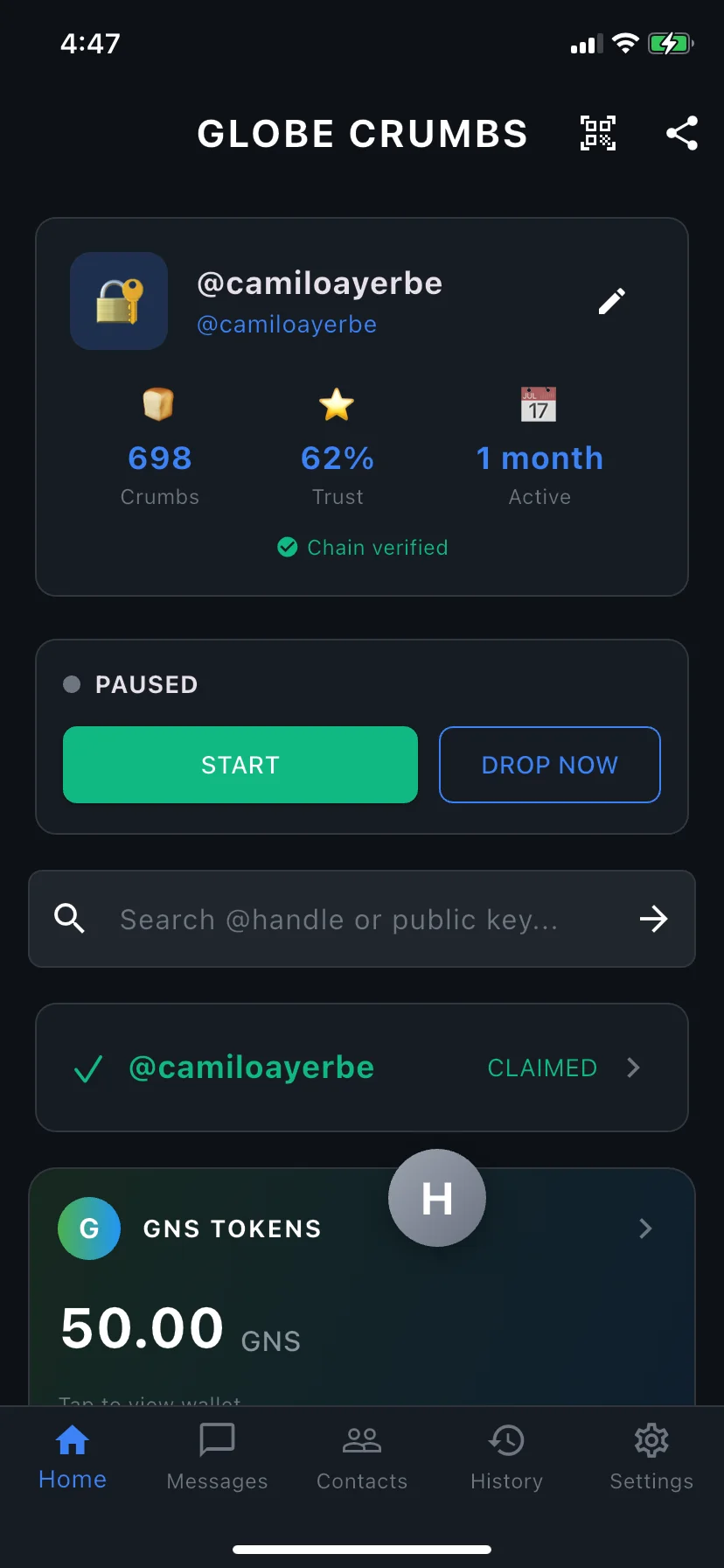
Identity Dashboard
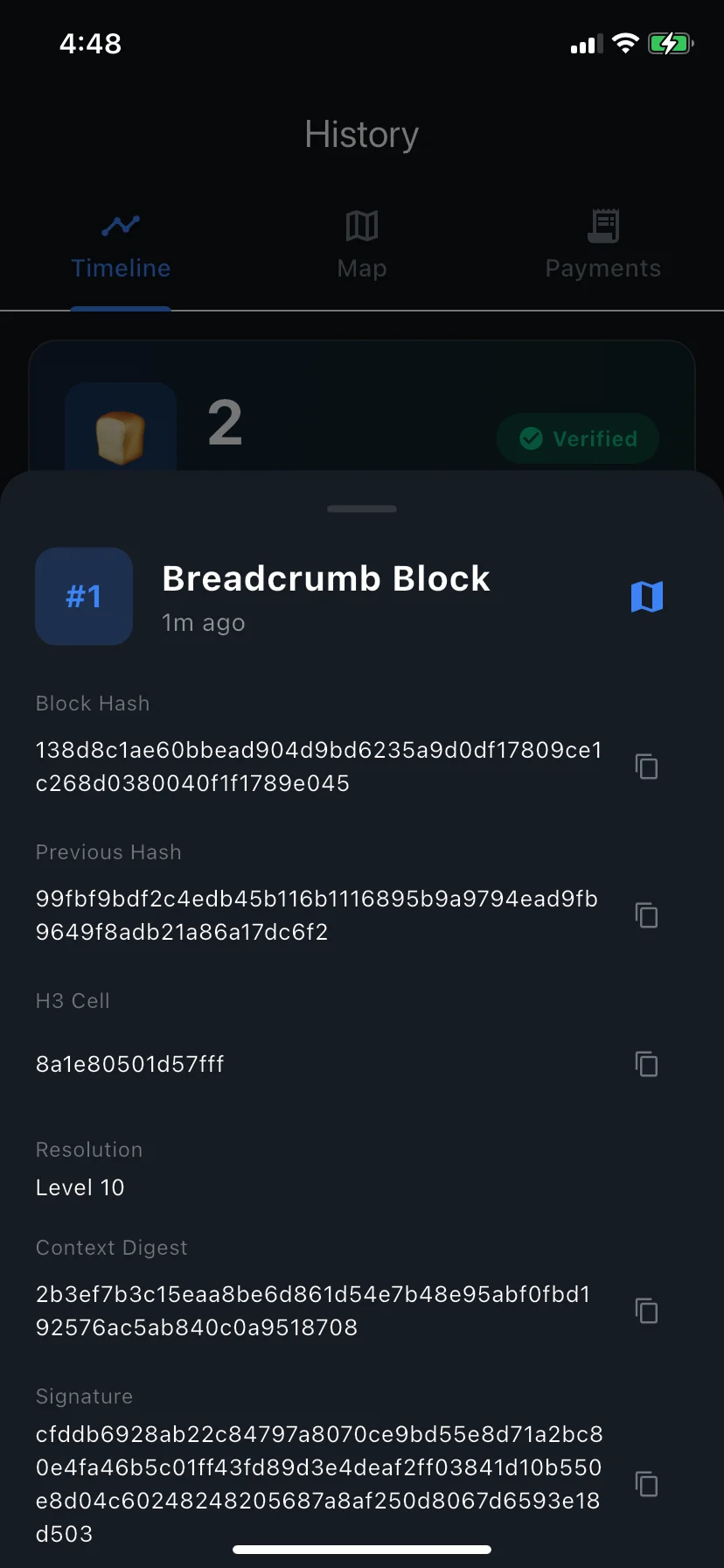
Breadcrumb Chain
Flocking Energy H v3 — Real-time human vs. bot classification using Parisi k=7 criticality analysis, IMU cross-correlation, and power spectral density.

Not a whitepaper. A working platform built on the GNS Protocol.
| Product | Description |
|---|---|
| Globe Crumbs Mobile | iOS/Android app for identity creation, messaging, and payments |
| Panthera Browser | Desktop/web app for identity exploration and communication |
| GNS API v1 | REST API for developers to verify identities and integrate GNS |
| Organization Portal | Namespace registration and member management |
GNS Protocol is built on ULissy — a domain-specific programming language designed for machines that move through physical space. 26,000 lines of Rust, full compiler pipeline, 74/74 TRIP protocol tests passing, CI green, live browser playground.
search nearby where trust > 0.5draft-ayerbe-trip-protocol-02Moving machines (phones, vehicles, drones, wearables) need specialized abstractions. ULissy treats identity, location, time, cryptography, and energy as first-class language primitives rather than library imports.
The core of GNS's Proof-of-Trajectory in 15 lines:
// Collect breadcrumbs to prove humanity
identity me = Keychain.primary

every 10.minutes when battery > 20% {
    let cell = here.h3(10)
    let prevHash = me.trajectory.last?.hash ?? "genesis"
    let hashInput = "\(cell)|\(now.millis)|\(prevHash)"

    let crumb = Breadcrumb {
        cell: cell,
        timestamp: now,
        hash: sha256(hashInput),
        signature: me.sign(hashInput)
    }

    me.trajectory.append(crumb)
}The same algorithm in traditional languages requires 200-300 lines of code with manual coordination between GPS APIs, cryptographic libraries, secure storage, and battery management.
// Initialize keychain
let keychain = Keychain::new()?;
let identity = keychain.get_or_create("primary")?;

// Setup location manager
let config = LocationConfig {
    accuracy: kCLLocationAccuracyHundredMeters,
    distance_filter: 100.0,
    activity_type: .other,
};
let manager = LocationManager::new(config);

// Battery check
let battery = UIDevice.current.batteryLevel;
if battery < 0.2 { return; }

// Get current location
let location = manager.current_location().await?;
let h3_index = h3::from_geo(
    location.latitude,
    location.longitude,
    10
)?;

// Build chain
let prev = storage.get_last_breadcrumb()?;
let prev_hash = prev.map(|b| b.hash)
    .unwrap_or("genesis".to_string());

// Hash computation
let input = format!("{}|{}|{}",
    h3_index,
    SystemTime::now()
        .duration_since(UNIX_EPOCH)?
        .as_millis(),
    prev_hash
);
let hash = Sha256::digest(input.as_bytes());

// Sign
let signature = identity
    .private_key
    .sign(input.as_bytes())?;

// Create breadcrumb
let crumb = Breadcrumb {
    index: prev.map(|b| b.index + 1).unwrap_or(0),
    timestamp: SystemTime::now(),
    cell: h3_index,
    hash: hex::encode(hash),
    signature: hex::encode(signature),
    // ... more fields
};

// Store
storage.append_breadcrumb(&crumb)?;
// ... 200+ more lines for error handling,
// background tasks, platform abstractions...identity me = Keychain.primary
every 10.minutes when battery > 20% {
let cell = here.h3(10)
let prevHash = me.trajectory.last?.hash
?? "genesis"
let hashInput = "\(cell)|\(now.millis)|\(prevHash)"
let crumb = Breadcrumb {
cell: cell,
timestamp: now,
hash: sha256(hashInput),
signature: me.sign(hashInput)
}
me.trajectory.append(crumb)
}
// That's it. Compiles to Rust.
// Runs on iOS, Android, Desktop.| Feature | Benefit |
|---|---|
| First-class Identity | identity me = ... declaration makes cryptographic keys a language primitive |
| Spatial Primitives | here.h3(10) — location is quantized for privacy automatically |
| Temporal Constructs | every 10.minutes when ... — scheduled tasks are syntax, not libraries |
| Energy Awareness | when battery > 20% — power constraints in the type system |
| Protocol Compliance | If it compiles, it follows the GNS Protocol. No room for violations. |
| Cross-Platform | One codebase → iOS, Android, Mac, Windows, Linux, WebAssembly |
Search is a language keyword, not a library. Every result is backed by cryptographic proof of existence:
// Find verified electricians nearby — ranked by trust
let results = search nearby(2.km)
    where trust > 0.5, facet == "services"
    ranked by trust desc

// Safe unwrapping of identity lookups
let alice = search @alice
if let peer = alice {
    let proof = peer.proof
    print("Trust: \(peer.trust), epochs: \(proof.epoch_count)")
}| Feature | What It Does |
|---|---|
| Full Compiler Pipeline | Lexer (1,231 lines) -> Parser (2,914) -> Type Checker (2,922) -> Code Generator (2,224) -> Rust output |
| 74/74 TRIP Tests | Complete protocol test suite passing — breadcrumb chains, epoch bundling, trust scoring, payments, IoT |
| GitHub Actions CI | Automated build, test (74/74), and lint (clippy + fmt) on every push. Badge: CI passing |
| EBNF Grammar | Formal specification: 93 production rules covering the complete language — docs/GRAMMAR.md |
| Browser Playground | Live tokenizer + AST + Rust preview in the browser — try it now |
search keyword |
4 query targets: nearby, within, @identity, "text" — compile-time privacy enforcement |
if let binding |
Safe Optional unwrapping: if let peer = search @alice { ... } |
| Typed filters | trust > 0.5, facet == "medical", active within 1.hour, org == "health_net" |
| Ranking keys | ranked by trust|distance|recency|relevance asc|desc |
| Privacy gate | Compiler rejects Trajectory, Breadcrumb, PrivateKey in search contexts. If it compiles, it's private. |
Protocol first, platform later.
GNS is positioning as the humanity verification primitive that existing auth providers will integrate, not compete against.
| Layer | Player | GNS Role |
|---|---|---|
| Application | Websites, Apps | Verify via OIDC |
| Authentication | Auth0, Okta | Add GNS as identity provider |
| Protocol | GNS | Proof-of-Humanity layer |
| Standard | TrIP (IETF I-D) | Formal protocol specification |
| Language | ULissy | Open-source foundation |
| Endpoint | Purpose | Pricing |
|---|---|---|
GET /v1/verify/{handle} |
Verify humanity and trust score | $0.01/call |
GET /v1/resolve/{handle} |
Resolve handle to public key | Free |
POST /v1/oauth/authorize |
OIDC authorization flow | $0.05/login |
POST /v1/webhooks |
Real-time identity events | $49/mo |
GNS works as a standard identity provider:
// Add "Login with GNS" to your app
const gnsAuth = new GNSAuth({
  clientId: 'your-client-id',
  redirectUri: 'https://yourapp.com/callback',
  scope: 'openid profile humanity'
});

// User clicks login
gnsAuth.authorize();

// Handle callback
const { handle, trustScore, verified } = await gnsAuth.handleCallback();

if (verified && trustScore > 0.8) {
  // Proceed with high-value action
}| Layer | Technology | Purpose |
|---|---|---|
| Language | ULissy | Domain-specific language for moving machines |
| Mobile | Flutter/Dart | iOS and Android app |
| Desktop | Tauri/Rust | Mac, Windows, Linux |
| Backend | Node.js/TypeScript | API and relay server |
| Database | Supabase (PostgreSQL) | Identity records, messages |
| Blockchain | Stellar | GNS token, payments |
| Geospatial | Uber H3 | Privacy-preserving location |
| Primitive | Algorithm | GNS Usage |
|---|---|---|
| Identity Keys | Ed25519 | Signing breadcrumbs, messages, records |
| Encryption Keys | X25519 | Key exchange for E2E messaging |
| Symmetric Cipher | ChaCha20-Poly1305 | Message encryption (AEAD) |
| Key Derivation | HKDF-SHA256 | Shared secret derivation |
| Hashing | SHA-256 | Breadcrumb chain, Merkle trees |
| Location Encoding | H3 (Level 10) | Privacy-preserving geospatial cells (~15,047 m²) |
GNS follows the Commercial Open Source Software (COSS) model — the same playbook used by GitLab, Elastic, HashiCorp, MongoDB, and Confluent to build billion-dollar companies on open-source foundations.
The protocol and developer tools are fully open source, maximizing adoption and community contribution:
| Component | License | Purpose |
|---|---|---|
| TrIP Protocol | IETF I-D (public) | Formal protocol specification — anyone can implement |
| ULissy Language | MIT | Compiler, runtime, standard library |
| trip-core | MIT | Rust reference implementation of TrIP |
| GNS Client SDKs | MIT | JavaScript, Python, Dart integration libraries |
| Globe Crumbs App | MIT | Mobile reference client (Flutter) |
Revenue comes from managed services, enterprise features, and premium API tiers that organizations need at scale:
| Product | Model | Target | Comparable |
|---|---|---|---|
| GNS Verify API | Usage-based SaaS | Developers, startups | Stripe API, Twilio |
| GNS Auth (OIDC) | Tiered subscription | Apps needing "is this human?" | Auth0, Okta |
| Organization Namespaces | Annual license | Companies, institutions | Google Workspace domains |
| GNS Enterprise | Contract + SLA | Banks, governments, large platforms | GitLab Ultimate, Elastic Cloud |
| Managed TrIP Nodes | Infrastructure-as-a-Service | Companies running private verification | Confluent Cloud, MongoDB Atlas |
| Tier | Monthly Price | Verifications | OAuth Logins | Support |
|---|---|---|---|---|
| Community | $0 | 5,000/mo | 500/mo | Community |
| Startup | $49/mo | 50,000/mo | 10,000/mo | |
| Growth | $149/mo | 200,000/mo | 50,000/mo | Priority |
| Enterprise | Custom | Unlimited | Unlimited | Dedicated + SLA |
$400K pre-seed via YC Post-Money SAFE at $4M valuation cap.
draft-ayerbe-trip-protocol-02)| Benchmark | Typical Pre-Seed | GNS Today |
|---|---|---|
| Product | Prototype or MVP | Full platform in production |
| IP | None | Patent pending + IETF I-D |
| Protocol spec | Whitepaper | Formal IETF standard submission |
| Language/toolchain | N/A | Working compiler (ULissy → Rust) |
| Blockchain | Testnet | Mainnet (Stellar) |
| Technical risk | High | Low — core protocol proven |
| Allocation | Amount | Purpose |
|---|---|---|
| US entity formation & ops | $40K | Delaware C-Corp, US banking, legal setup, registered agent |
| Protocol hardening | $80K | trip-core Rust crate, mobile FFI bridge, second IETF implementation |
| Engineering hire | $100K | First senior engineer (Rust/systems) — 12 months at early-stage comp |
| Developer ecosystem | $60K | Documentation, LSP, module registry, API developer portal |
| Go-to-market (US) | $60K | First 10 US integration partners, developer relations, content |
| IP & legal | $35K | Full US patent prosecution, COSS license counsel, IETF participation |
| Infrastructure | $25K | US-region cloud (Railway/AWS), Supabase, Cloudflare — 18 months |
| Milestone | Timeline | Significance |
|---|---|---|
| Delaware C-Corp formed | Q2 2026 | US-ready for partnerships and follow-on |
| trip-core crate published on crates.io | Q2 2026 | Second IETF implementation, Rust ecosystem adoption |
| First senior engineer onboarded | Q2 2026 | Team beyond solo founder |
| 10 US API integration partners | Q3 2026 | Product-market validation, first revenue |
| 5,000 @handles claimed | Q3 2026 | Network effect activation |
| TrIP BOF session at IETF 126 Vienna | July 2026 | Working Group formation — Standards Track progression (BOF proposal deadline: May 22, 2026) |
| $25K MRR | Q4 2026 | Seed-ready revenue signal |
| SOC 2 Type I compliance | Q1 2027 | Enterprise-ready for US market |
Native utility token on Stellar blockchain.
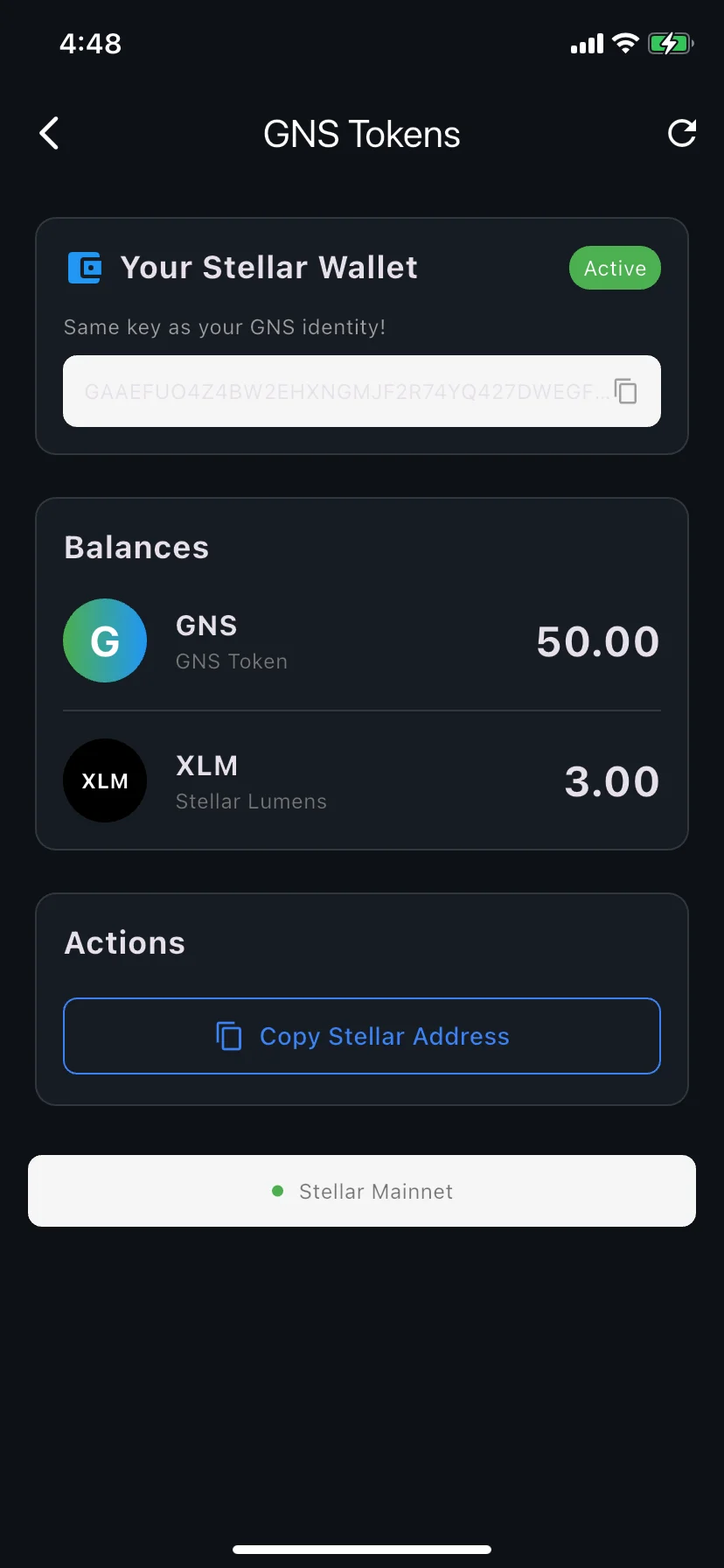
Stellar Wallet
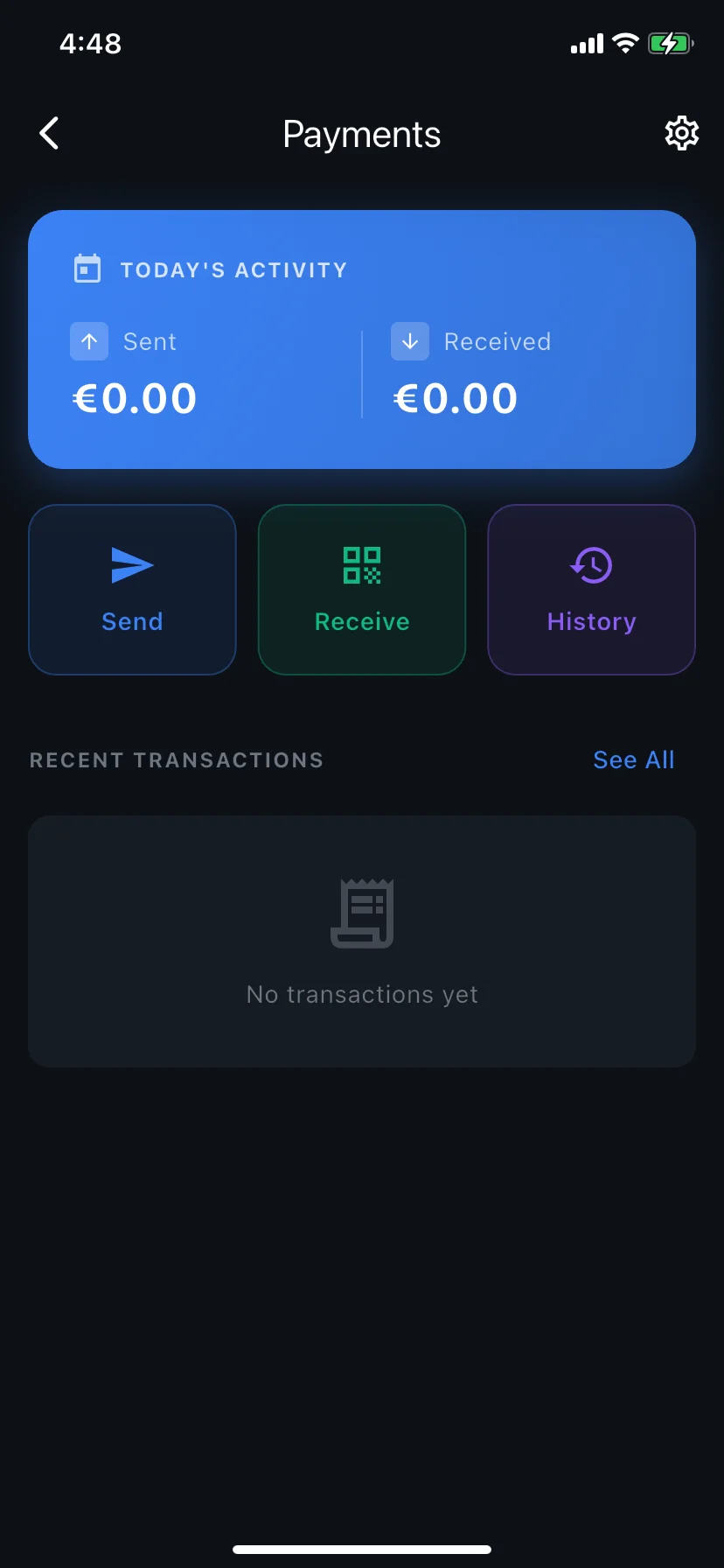
Send & Receive
B2B revenue through corporate identity management.
| Tier | Price/Year | Members | Example |
|---|---|---|---|
| Starter | $49 | 1-5 | freelance@mario |
| Team | $99 | 6-25 | acme@team |
| Business | $249 | 26-100 | startup@staff |
| Enterprise | $499 | 101-500 | corp@global |
| Unlimited | $999 | Unlimited | amazon@world |
| Feature | GNS + ULissy | WorldCoin | Auth0 |
|---|---|---|---|
| Answers "Is this human?" | Yes | Yes | No |
| Proof Method | Behavioral | Iris scan | N/A |
| Hardware Required | Phone only | Orb ($300K) | None |
| Privacy | High (H3 cells) | Medium | Low |
| OIDC Compatible | Yes | No | Yes |
| Open Source Language | ULissy | No | No |
| IETF Standard | Yes (I-D revision -02, RATS WG co-author) | No | No |
| Cost per Verification | $0.01 | N/A | $0.07/MAU |
| Spatial Discovery | TrIP Search (language-native) | No | No |
| Compile-Time Privacy | Yes (ULissy enforced) | No | No |
Space object identity via Proof-of-Trajectory. The first vertical that generates revenue without consumer adoption.
The other four GNS verticals (Ad Fraud, Creator Economy, Content Protection, NFC Payments) all require consumer-scale user adoption before revenue flows. Orbital TrIP inverts this: 70+ satellites are tracked live today using existing public observation data. The buyers are ~30-50 insurance brokers globally, and the industry is bleeding money at a 179% combined loss ratio.
Critically, Orbital TrIP does NOT require onboard hardware. Like DNS, the registry assigns identity based on external observation:
| Tier | Method | Hardware Required | Trust Score | Status |
|---|---|---|---|---|
| Tier 1: Ground-Attested | CelesTrak/Space-Track radar observations → Ed25519 breadcrumb chains built on behalf of satellite | None — zero satellite cooperation | Base | Live today (70+ sats) |
| Tier 2: Operator-Attested | Operator signs own telemetry with GNS keypair before publishing to Space-Track | Software only — ground segment change | Enhanced | Phase 2 (2027) |
| Tier 3: Self-Attested | Onboard Ed25519 signing chip signs GPS fixes and downlinks signed breadcrumbs | CubeSat identity module | Maximum | Phase 3 (2028) |
google.com without Google installing special hardware in their servers, the GNS Foundation assigns trajectory identity to space objects based on external observation. The satellite doesn't need to know it's being tracked.
Orbital TrIP captures value across four distinct layers, each targeting a different buyer with a different willingness to pay. The public registry (ICANN model) remains free — all revenue flows through Globe Crumbs Inc.
| Tier | Target | What They Get | Price |
|---|---|---|---|
| Public Dashboard | Everyone | Trust scores, ground tracks, anomaly alerts, Trajectory Badges | $0 (free) |
| Starter | Small brokers, researchers | API access, 50 satellites, basic trust trends | $500/month |
| Professional | Regional brokers, underwriters | Full catalog, raw breadcrumb data, evidence chains, fleet analytics | $2,000/month |
| Enterprise | Global brokers (Aon, Marsh), Lloyd's syndicates | Dedicated instance, custom scoring models, SLA, real-time webhooks | $5,000-15,000/month |
Parametric insurance pays out automatically when a pre-defined threshold is met. TrIP provides the independent verification that triggers the payout — eliminating manual claims adjustment.
| Trigger Event | Example | Fee per Verification |
|---|---|---|
| Orbital Insertion Confirmation | Satellite reaches target orbit within parameters | $5,000 - $25,000 |
| Station-Keeping Deviation | GEO satellite drifts beyond insured tolerance | $2,000 - $10,000 |
| End-of-Life Disposal Verification | Satellite moved to graveyard orbit per guidelines | $5,000 - $15,000 |
| Anomaly Detection Alert | Unexpected maneuver, breakup event, proximity approach | $1,000 - $5,000 |
Satellite operators pay for certified TrIP compliance reports to demonstrate responsible behavior and negotiate lower insurance premiums. Regulators increasingly require debris mitigation evidence.
| Report Type | Buyer | Fee |
|---|---|---|
| Annual Station-Keeping Compliance | GEO operators | $5,000 - $10,000/year |
| Debris Mitigation Performance | LEO constellation operators | $2,000 - $8,000/year |
| ESG Space Sustainability Report | Public companies, institutional investors | $10,000 - $25,000/year |
| Forensic Incident Report | Insurers, regulators (post-event) | $15,000 - $50,000 per event |
Deep integration into the internal pricing engines of major reinsurers (Munich Re, Swiss Re, AXA XL). Licensed platform deployment with real-time webhooks that alert their risk systems the moment a satellite's Trust Score drops.
| Offering | Target | Price |
|---|---|---|
| TrIP Scoring Engine License | Top-10 global reinsurers | $50,000 - $150,000/year |
| Custom Risk Model Integration | Lloyd's syndicates, specialty underwriters | $25,000 - $75,000/year + setup |
| Real-Time Webhook Feed | Automated underwriting platforms | $10,000 - $30,000/year |
| Stakeholder | Key Offering | Model |
|---|---|---|
| Global Brokers (Aon, Marsh, Willis) | Risk benchmarking, fleet monitoring, lead generation | Tiered SaaS Subscription |
| Underwriters (Lloyd's, AXA XL) | Parametric trigger verification, forensic audit | Per-event fee + DaaS |
| Operators/Issuers (SpaceX, SES, Intelsat) | Compliance reports for premium reduction | Audit fee / Certification |
| Reinsurers (Munich Re, Swiss Re) | White-label scoring engine integration | Platform license |
| Revenue Layer | Year 1 | Year 2 | Year 3 |
|---|---|---|---|
| Satellites tracked | 500+ | 5,000+ | 45,000+ |
| L1: API Subscriptions | €72K (5 clients avg $1.2K/mo) | €540K (20 clients avg $2.25K/mo) | €2.7M (40 clients avg $5.6K/mo) |
| L2: Parametric Triggers | €50K (5 events × $10K avg) | €300K (25 events × $12K avg) | €1.5M (75 events × $20K avg) |
| L3: Compliance Audits | €60K (10 reports × $6K avg) | €400K (50 reports × $8K avg) | €2.0M (200 reports × $10K avg) |
| L4: White-Label Licenses | €0 (relationship building) | €150K (2 licensees × $75K) | €750K (5 licensees × $150K) |
| TOTAL ORBITAL TrIP | €182K | €1.39M | €6.95M |
The Orbital TrIP public registry is live now at orbital-trip-production.up.railway.app — tracking 70+ satellites with live CelesTrak data, Ed25519 breadcrumb chains, trust scoring, and 5 narrative "story satellites" including Russia's GEO stalker (Luch/Olymp-K2) and the ISS ASAT shelter event.
Founder Identity: @camiloayerbe
TrIP is on track for formal IETF standardization. Co-authored with Usama Sardar from the IETF Remote Attestation Procedures (RATS) Working Group, providing internal advocacy within the IETF ecosystem.
| Milestone | Date | Status |
|---|---|---|
| draft-ayerbe-trip-protocol-00 | Dec 2025 | Done — Initial submission |
| draft-ayerbe-trip-protocol-01 | Jan 2026 | Done — Added Flocking Energy analysis, Parisi k=7 |
| draft-ayerbe-trip-protocol-02 | Feb 2026 | Done — Usama Sardar co-authorship, RATS WG alignment |
| BOF Proposal Submission | May 22, 2026 | Deadline — Birds of a Feather session request for IETF 126 |
| IETF 126 Vienna — BOF Session | July 2026 | Target: Working Group formation vote |
| Working Group adoption | Q4 2026 | TrIP becomes a WG document, multi-stakeholder review |
| RFC publication | 2027-2028 | TrIP becomes an Internet Standard |
| Term | Definition |
|---|---|
| TrIP | Trajectory-based Recognition of Identity Proof. The formal protocol specification submitted to the IETF as an Internet-Draft. Defines breadcrumb wire format, epoch aggregation, TIT derivation, and trust computation independently of any application layer. |
| TIT | Trajectory Identity Token. A 128-bit pseudonymous identifier derived from an Ed25519 public key and genesis breadcrumb hash. Persistent, deterministic, and cryptographically bound to a trajectory. |
| COSS | Commercial Open Source Software. Business model where the core protocol and tools are open-source (MIT), while managed services, enterprise features, and premium API tiers are proprietary. Used by GitLab, Elastic, MongoDB, and HashiCorp. |
| @handle | A human-readable identity name claimed by a user after collecting 100+ breadcrumbs. Permanent, globally unique, and owned forever. |
| Breadcrumb | A cryptographically signed location proof. Contains: H3 cell, timestamp, previous hash, context digest, and Ed25519 signature. |
| Proof-of-Trajectory (PoT) | GNS's core innovation. Proves humanity through behavioral patterns (movement over time) rather than biometrics. |
| ULissy | Domain-specific programming language for moving machines. Treats identity, location, time, and cryptography as first-class primitives. Transpiles to Rust. Current version: v0.4.2. 26,000 lines, 74/74 TRIP tests, CI green. |
| Flocking Energy | Trajectory Criticality Engine. Analyzes movement patterns using Parisi k=7 criticality, PSD (1/f noise), IMU cross-correlation, gyration radius, and phase-space attractors to distinguish human trajectories from GPS spoofing, random bots, and deterministic bots. |
| TrIP Search | Spatial-identity discovery layer. Search is a first-class ULissy keyword — search nearby(500.m) where trust > 0.5 compiles to type-safe, privacy-enforced queries. Every result is backed by cryptographic proof of physical existence. |
| Orbital TrIP | Application of TrIP to space objects. Creates cryptographic identity for satellites using SGP4-propagated orbits signed with Ed25519. Three attestation tiers: Ground-Attested (no hardware), Operator-Attested (software only), Self-Attested (onboard module). Live public registry at orbital-trip-production.up.railway.app. |
| Trust Score | A 0-100% metric derived from breadcrumb history. Higher scores indicate longer, more consistent movement patterns. |
| Verification Level | A tiered classification (none/basic/standard/advanced/maximum) based on breadcrumb count and trust score. |
| H3 Cell | Uber's hexagonal hierarchical geospatial indexing system. GNS uses Level 10 cells (~15,047 m²) for privacy. |
| IDUP | Identity-based Universal Payments. Send money to @handles instead of wallet addresses. |
| Facet | A protocol-specific identity layer. Examples: chat@, dix@, email@, home@. |
| DIX | Decentralized Information Exchange. GNS's public social layer for posts and broadcasts. |
| gSite | Your personal identity page hosted on the GNS network. Customizable with themes, bio, and links. |